You have never passed through a half-painted living room with your phone pressed to your ear and your roller in one hand, with your mobile phone vigorously searching on Google, then you’ve been there as well. This is one of the most frequently asked questions that we receive at City Painters WA… and it actually is one of the easiest possible errors to make!
In summary: most (acrylic) water-based paints require 4 to 6 hours for recoating; oil-based paints require 16 to 24 hours. But that’s just the beginning. What you need to know depends on your paint type, where you are working, the humidity, temperature, and whether you are working inside or outside the room.
Let’s do this right, because if you get it wrong, you won’t just be wasting your Saturday; you’ll be ruining your paint job as well.
A client’s story: renovation that went wrong… almost!
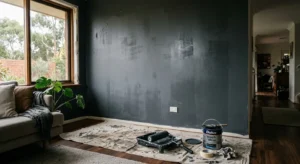
Some months ago, we had one of those ‘Sarahs’ living rooms in the South of Perth, and she wanted to do the painting herself on a long weekend. She was excited: quality paint she had purchased, and she was counting on finishing the two coats by Sunday night.
The problem? To beat the clock, she applied her second coat 90 minutes after her first. On Monday morning, the wall was showing signs of being patchy, with paint marks seen from the roller and uneven paint. Some areas of paint had started to peel at the edge.
Sarah called in frustration/disheartened us. The paint recoat time had not been adhered to. It’s immediately apparent when you take the time to inspect the wall. Any second coat that was applied couldn’t stick to the first due to improper curing. It’s a frequent error that just doesn’t need to happen when you know the fundamentals of paint drying.
In the end, I sanded and repainted the affected areas, providing the correct drying time between the various coats of paint. That all turned out to be a very good thing, and she received a nice long-lasting finish, the one she desired in the first place.
Paint Drying Time: The Importance
Paint is not all about to “dry”; it undergoes two drying processes: drying (when the paint is hard enough to touch) and curing (when the paint has completely hardened and molecularly bonded). This is a step that most “DIYers” skip.
If you apply multiple coats early, then you can:
- Continuously retain moisture underneath the skin, causing bubbles or peeling.
- The first coat should be moved around with the roller or brush to create a drag or lift.
- This will make for an uneven and patchy final product once dry.
- This will make the entire paintwork less durable.
This is the reason you don’t want to just know about paint recoat time; you want to know it. To say that is why having knowledge about the paint recoat time is not “a good to have” but “a need to have” is understating it.
The following is an illustration of how long to wait between coats of paint, depending upon the type of paint applied.
Not all paints wait for the same amount of time. This is a general guide, based on products that are used most frequently on Perth and WA properties:
- Water-based (acrylic/latex): give 4 to 6 hours between layers, allowing overnight for the best performance.
- Oil-based (enamel) paint: Let dry 16 to 24 hours between coats.
- Wait at least 1 to 2 hours (depending on the formula) after you apply it before putting your baby down to sleep.
- Ceiling (and trim) paint: may be the same color as wall paint, but is always dependent on the wall paint on the tin.
Generally, we advise all of our clients with the same thing: “Read the tin, but trust the environment too! Manufacturer times are calculated under ideal conditions in a laboratory, such as hydro (21°C) and medium (moderate humidity), which may not be ideal for your WA home.”
When thinking about paint drying time, consider the difference between interior and exterior paint drying times.
This is where a lot of confusion has arisen, as the interior and the exterior are worlds apart.
The drying time of interior paint is more predictable. Indoors are warm and still, with a regulated level of humidity, especially when air conditioning is used, or it’s well ventilated. Water-based paints used in the interior of most homes are safe to recoat within 4 to 6 hours of application in Perth.
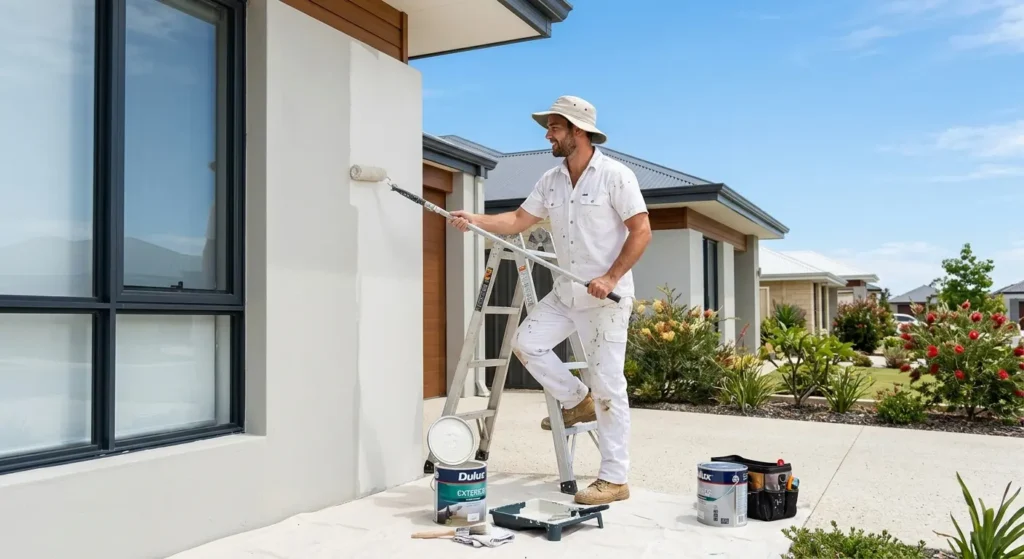
Exterior paint drying time, however, is subject to other considerations that you have little control over. How a coat cures can be influenced by direct exposure to the sun, the dryness of WA’s weather, coastal humidity and even overnight dew. This could leave the surface feeling dry in an hour or less on a Perth summer day, but it doesn’t necessarily mean it is cured through. However, if you paint too early in the morning, when it is damp with dew or moisture on the surface, it will create moisture under the film of the second coat.
There are a few additional factors to consider when drying outside:
- If exposed to direct sunlight, the surface might dry out too quickly, causing cracking.
- Note that high humidity can have a significant impact on curing, despite the apparent lack of moisture on the surface.
- Drying effects of wind are beneficial but may add dust and dirt to wet paint.
- When the evening temperatures are cooler, recoat times may be longer at night.
Though this is hard to determine without experience, it is often why professional painters will come up with an alternative schedule that is flexible around the weather forecast instead of the clock.
Our Professional Recommendation
City Painters WA have tackled numerous interior and exterior painting projects around Perth and WA that can be done anywhere, and if there was one take-home message, it would be this: Patience is key! Following the same thought, a rush job test run of the second coat will nearly inevitably cost even more time (and money) in the long run because of whatever repairs, sanding, or full repaint is required.
In general, we advise everyone, all our clients, friends, and consumers of our blog:
- Please see the manufacturer’s instructions on the tin always.
- Consider increasing the drying time in humid, coastal areas and when it is cloudy.
- Don’t paint the outside of the house in the hottest hours. If practical, avoid painting exteriors during the hottest hours.
- If in doubt, wait longer, as it does a lot more harm than help when it is not waited long enough.
But when in doubt, always contact painting experts who know how climate conditions in WA impact paint work, as no two rooms, walls, or weather days are the same!
FAQs: How Long to Wait Between Coats of Paint
Q: How long should I wait between coats of interior paint?
A: Most water-based interior paints need 4 to 6 hours before recoating, though waiting overnight gives the best, most durable finish.
Q: How long should I wait between coats of exterior paint?
A: Exterior paint drying time varies with weather, but generally allow at least 6 to 8 hours, and avoid recoating during extreme heat, humidity, or early morning dew.
Q: Can I recoat paint too soon?
A: Yes, recoating too early is one of the most common painting mistakes. It can trap moisture, cause peeling, and leave an uneven finish, as it prevents proper bonding between coats.
Q: Does temperature affect paint drying time?
A: Absolutely. Higher temperatures speed up surface drying but can affect curing quality, while cooler or humid conditions slow the whole process down significantly.
Q: Is paint drying time the same as curing time?
A: No. Drying refers to the surface feeling dry to the touch, while curing is the full hardening process, which can take days or even weeks depending on the paint type.
Not sure how long to wait, or want it done right the first time? Get in touch with City Painters WA today for a free consultation, and let our experienced team handle the timing, so you don’t have to.