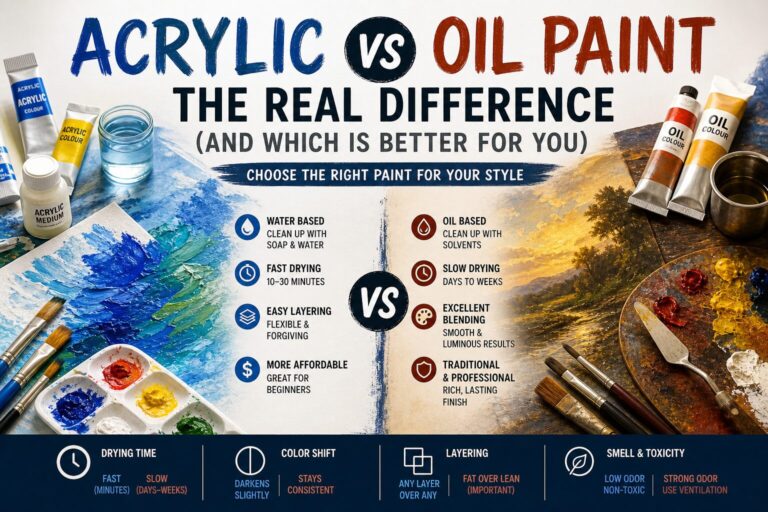
Walking into an art supply store and standing in front of a wall of tubes, almost every new painter ends up asking the same question: should I pick acrylic or oil? Both can produce gallery-worthy work, both have been used by world-famous artists, and both come in stunning ranges of color. But the difference between oil paint and acrylic paint runs much deeper than price or smell, and choosing the right paint medium for your style can save you years of frustration.
This guide breaks down the difference between oil painting and acrylic in plain language, covering everything from chemistry and drying times to whether you can paint oil over acrylic. By the end, you’ll know exactly which one fits the way you actually want to paint.
What Acrylic Paint and Oil Paint Are Actually Made Of
Most painters never bother opening up the chemistry, but five minutes here will save you hours of confusion later. The reason is simple: nearly every quirk you’ll run into at the easel, why the colour shifted overnight, why your top layer cracked, why the brush turned into a rock, traces straight back to the glue holding the colour together.
Think of any paint as three things stirred into a paste: a colour (the pigment), a glue that traps the colour on your canvas (the binder), and something thin to push it around with (the solvent). Swap the glue, and you’ve basically built a different paint.
For acrylic paints, the glue is liquid plastic, microscopic acrylic polymer beads floating in water like flour in a glass. While the paint is wet, it stays loose and brushable. Once you put it down, the water packs up and leaves, the plastic beads collide into each other, and they fuse into a single rubbery sheet that grips the pigment in place forever. So if you’ve ever wondered, “is acrylic paint water based?”, that’s your answer in one sentence: water carries the plastic, the plastic holds the colour, and water is what cleans up the leftovers. This is why a tap and a bar of soap is the entire cleanup ritual for water based acrylic.
For oil paints, the glue is a drying oil pressed from seeds, usually linseed, sometimes walnut or safflower for whites and pale colours. There’s not a drop of water anywhere. Oil based to the core, this paint sets through a chemistry experiment that runs in slow motion: the oil pulls oxygen out of the air for days and weeks, knitting itself together molecule by molecule into a tough, glassy film. The trade-off is that water can’t touch it. To thin the paint or scrub a brush, you have to reach for turpentine, odourless mineral spirits, or one of the gentler artist solvents.
That one swap, plastic glue versus oil glue, is the parent of almost every other difference you’ll read about for the rest of this article. Drying time, blending window, layering rules, even whether your great-grandkids see the same colours you painted: all of it falls out of that one decision.
Drying Time: The Biggest Difference Between Oil and Acrylic Paints
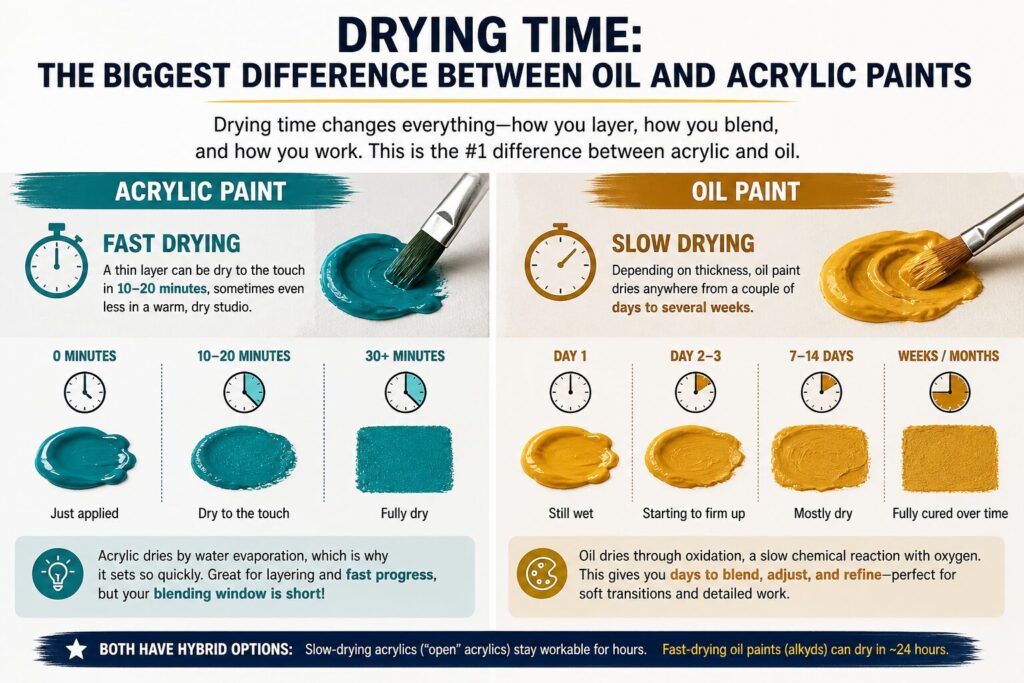
If you remember only one thing about acrylic vs oil, make it this: drying time changes everything.
Acrylic paint is a fast drying medium. A thin layer can be dry to the touch in 10 to 20 minutes, sometimes even less in a warm, dry studio. The acrylic medium dries quickly because it relies on water evaporation rather than a chemical reaction. This quick drying behaviour is fantastic for building up layers without long waits, but it also means you have a very small window to blend wet-into-wet on the canvas before the paint sets.
Oil paint is the opposite. The slow drying time is the headline feature. Depending on how thick you apply it, oil paint drying can take anywhere from a couple of days to several weeks, and a thickly painted impasto piece can technically continue curing for months. This slow drying gives you days to come back to a passage and blend it seamlessly, which is why oils are the historic choice for portrait painters, classical realists, and anyone chasing soft, luminous transitions.
Both paints have hybrid versions that bend these rules. There are slow drying acrylic mediums called “open” acrylics that stay workable for hours, and there are alkyd-based oil paints that dry in roughly 24 hours. But by default, the gap between the two is enormous.
| Factor | Acrylic Paint | Oil Paint |
|---|---|---|
| Binder | Acrylic polymer emulsion | Drying oil (linseed, walnut, safflower) |
| Solvent | Water | Turpentine or mineral spirits |
| Drying time | 10–30 minutes (thin layer) | 1 day to several weeks |
| Drying mechanism | Water evaporation | Oxidation and polymerization |
| Cleanup | Soap and water | Solvents and artist’s soap |
| Yellowing | Stable, doesn’t yellow over time | Can yellow over time (especially whites) |
| Color shift | Darkens slightly when dry | Stays roughly the same |
| Smell | Mild to none | Strong (from solvents) |
| Cost | Generally more affordable | Paints and mediums cost more |
| Beginner-friendly | Easier cleanup, faster results | More forgiving for blending |
How They Behave on the Canvas
Beyond the science, what does it actually feel like to paint with each one?
Acrylic paint has a workable, slightly buttery feel when fresh from the tube, but you’ll notice it starts to “tack up” within minutes of being on your palette. Many acrylic painters keep a spray bottle of water nearby just to keep their palette workable. The versatility of acrylic is real, though. You can thin it with water for watercolour-like washes, mix it with gel medium for sculptural impasto, pour it for fluid abstracts, or use it for crisp hard-edged geometric work. Few mediums let you switch styles so freely.
One quirk worth knowing: acrylic paints dry slightly darker than they look wet. The acrylic medium is white when wet but dries clear, so colours appear lighter on the palette and a touch deeper once cured. Experienced acrylic painters compensate by mixing colours a shade lighter than they want them to read.
Oil paints feel completely different. They stay buttery and movable for hours, sometimes days. Brush marks hold their shape beautifully, peaks of impasto don’t slump, and you can blend two colours into a perfect gradient by simply working back into them tomorrow morning. The colour you mix is roughly the colour you’ll see on the wall, with very little drying shift, although the binder oil itself can yellow over time, which is part of why old master paintings have that warm, amber glow. Modern oil paints and stable whites have reduced this yellow-over-time effect, but it hasn’t disappeared entirely.
Layering: The Rules Are Completely Different
This is where most beginners trip themselves up, usually months after the painting is finished, when they notice tiny cracks running through their best work.
Acrylics are essentially rule-free when it comes to stacking. Once a layer is dry, which is approximately as long as it takes to make tea, you can paint anything you want on top of it. Thick on thin, thin on thick, glaze, scumble, hard edge, wash, it all works. The dried paint film is rubbery, water resistant when dry, and bonds to itself so cheerfully that you can build twenty layers without ever worrying about adhesion. Acrylics will even let you do “lean over fat”, layering a watery wash across thick-bodied paint, which is a move that would slowly destroy an oil painting from the inside.
Oils are not so forgiving, and they want you to learn one specific rule before you go too far: fat over lean. The vocabulary is older than it sounds. “Fat” just means more oil in the mix; “lean” means more solvent and less oil. The rule itself is short, every layer you add should have at least as much oil as the layer underneath it, and ideally a bit more.
Here’s the easiest way to picture why. Imagine icing a cake while the cake is still rising. The icing on top has gone hard and brittle, but the cake underneath is still puffing up, expanding, shifting around. Something has to give, and what gives is the icing: it cracks across the top in a web of fine lines. Oil paint does almost exactly that. A lean layer over a fat one becomes the brittle icing, while the fatty layer underneath keeps drinking in oxygen and slowly swelling for months. By the time the underlayer is fully cured, the top has already split.
Run the rule the other way and the problem disappears. Lean layers underneath dry quickly and lock down hard. Fatter, oilier layers on top stay flexible and follow whatever movement happens below them. That’s why most oil painters start with thin, solvent-loaded underpaintings, switch to paint straight from the tube in the middle stages, and finish with the most oil-rich, glossy passages on the very top.
Can You Paint Oil Over Acrylic? (And Why the Reverse Will Wreck Your Painting)
This question comes up so often it deserves its own section, partly because the answer opens up a genuinely useful workflow most beginners never realise exists.
Yes, oil sits perfectly happily on top of dried acrylic. The reason is almost accidental: a fully cured acrylic surface is chemically very close to acrylic gesso, which has been the standard primer for oil painting for decades. The acrylic dries into a slightly toothy, mildly absorbent layer that grips oil paint about as well as any traditional ground would. Plenty of working artists exploit this on purpose: they sketch and block in the whole composition with acrylics in a single afternoon (because the paint sets in minutes), then switch to oils for the parts of the painting that actually need slow blending and rich depth. You get the speed of acrylic underneath and the luxury of oil on top.
Going the other direction is a small disaster waiting to happen. Putting acrylic over oil might look fine on day one. It can even feel like it’s gripping. But the oil layer is, fundamentally, oily, and water-based acrylic refuses to bond properly to anything greasy, the same reason salad dressing separates in the bottle. Within weeks or months, the acrylic film begins to lift, peel, or flake away in sheets. There’s no medium, primer, or technique that reliably fixes this. Once a passage is in oil, it has to stay in oil.
So the rule lives in a single sentence, easy to keep in your head while you work: acrylic first, oil last, never the other way around.
Cleanup, Health, and Studio Setup
For a lot of painters, this is where the choice gets practical.
Acrylic cleanup is genuinely easy. Wet acrylic comes off brushes with warm water and a little soap. You don’t need solvents, you don’t need ventilation, and you don’t have to worry about flammable rags. Most modern acrylic paints are labelled non-toxic and are safe to use around children, which is partly why acrylics dominate school art rooms and home studios.
Oil cleanup is more involved. Brushes need to be cleaned with mineral spirits or solvent first, then washed with artist’s soap. Solvent-soaked rags are a fire hazard if you bunch them up (the oxidation reaction can generate enough heat to spontaneously combust), so they need to be laid flat to dry or stored in a sealed metal can. Ventilation matters too, since traditional turpentine releases vapours that you don’t want to breathe in for hours every day. Odourless mineral spirits and water-mixable oils have made things friendlier, but oil painting still demands a more deliberate studio setup than acrylics do.
For artists in apartments, shared spaces, or homes with kids and pets, acrylics or water-mixable oils are usually the more sensible call.
Cost and Longevity
Acrylics are generally more affordable across the board. The paints cost less, you don’t need expensive mediums or solvents, and brushes last longer because cleanup is gentler on bristles. A beginner can put together a complete acrylic kit for a fraction of what an equivalent oil setup costs.
Oils are more expensive, both for the paints (especially professional grade) and for the mediums, solvents, and supports you’ll need to use them properly. House paints and craft acrylics are not in the same league as artist-grade acrylic paints, and the same is true for cheap oil paint. If you go the oil route, budget a bit more from the start.
On longevity, both can last for centuries when done properly. Oil paintings from the 1500s are still hanging in major museums. Acrylics have only existed since the mid-20th century, but laboratory tests project that acrylic paint films will remain colourfast and stable far into the future. The acrylic polymer doesn’t yellow the way oil binders do, which is actually a long-term advantage.
Are Oil or Acrylic Paints Better? Acrylic or Oil Painting Which Is Better for You
Now for the question almost everyone really wants answered: are oil or acrylic paints better, and which one is right for me?
Honestly, neither is “better” in any universal sense. They’re different tools, and the right one depends on your style, your patience, and your studio.
Choose acrylic paint if you:
- Want to start painting today with minimal setup
- Like working fast and building up layers in a single session
- Prefer crisp edges, flat colour blocks, mixed media, or pouring techniques
- Don’t have a ventilated studio or want to avoid solvents entirely
- Are on a tight budget
- Are painting with kids around, or want a non-toxic option
- Enjoy switching between watercolour-like washes and thick impasto in the same piece
Choose oil paint if you:
- Love slow, careful blending and soft transitions (portraits, classical realism, atmospheric landscapes)
- Want the colour you mix to be the colour that ends up on the canvas
- Don’t mind setting up a proper studio with ventilation and solvent management
- Enjoy the meditative pace of working over hours and days rather than minutes
- Want that buttery, sculptural feel that holds brushstrokes and peaks
- Are drawn to the deep, glossy luminosity of traditional oil painting
If you’re stuck between them and can afford it, the smartest move is to try both. Many professional painters work in both mediums and choose between them based on the subject. Acrylics for an abstract poured piece, oils for a portrait. You don’t have to pick a side forever.
A Few Beginner-Friendly Hybrid Options
If neither paint sounds quite right, the modern hybrid options are worth knowing about:
Open or “interactive” acrylics stay wet for hours instead of minutes, giving you closer-to-oil blending behaviour while keeping the water-based, low-toxicity workflow.
Water-mixable oil paints are real oil paints reformulated so the binder accepts water. You get the slow drying time and the rich feel of oils, but you can clean brushes in the sink and skip turpentine entirely. They’re an excellent compromise for apartment-bound oil painters.
Alkyd oil paints dry overnight instead of over weeks. They’re traditional oil paints with a synthetic resin added to speed drying, useful for underpainting layers or for artists who hate waiting.
Final Word
The difference between oil paint and acrylic paint isn’t really about which one is more “serious” or more “professional.” Both have produced masterpieces, both are used by working artists at the highest level, and both can carry your work for the rest of your life if you commit to learning them.
The real question is what kind of painter you want to be. If you crave momentum, instant feedback, and freedom to experiment with mixed media, water based acrylic is going to feel like an extension of your hand. If you crave depth, blending time, and the weight of a 600-year-old tradition, oil paint will reward every hour you put into it.
Pick the one that excites you most, buy a small starter set, and start painting. You’ll learn more from one finished canvas than from a hundred articles, including this one.