
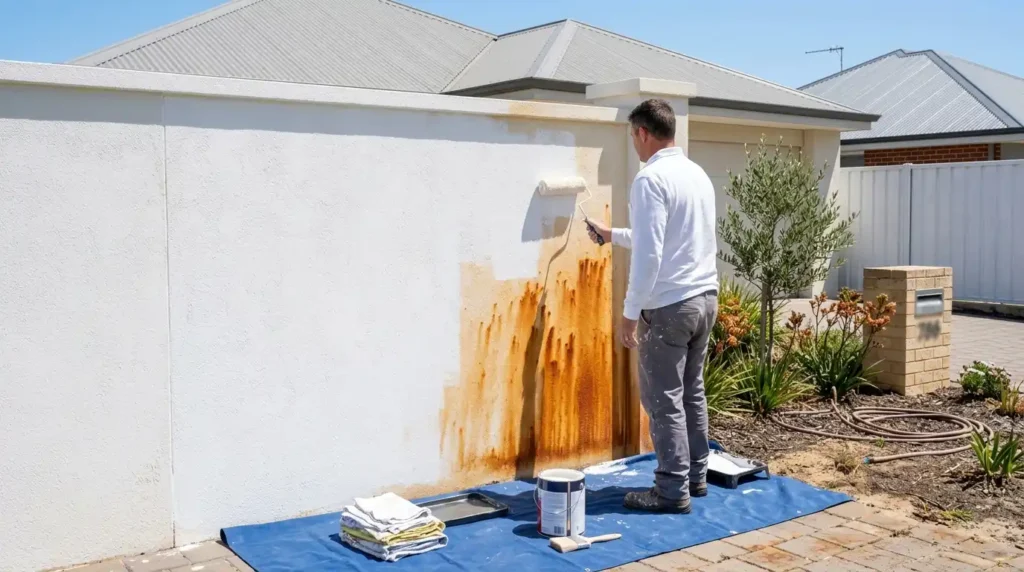
You’ve cleaned the render and washed the fence. So that rusty orange streak is still there, maybe not so loud and great, just somewhere after all, and it’s back next weekend.
If your garden is powered by a bore, then you have most likely maintained bore water stains. These are all found on walls, Colorbond and timber fences, paving, letterboxes and even windows. One of the most frequently asked questions from Perth homeowners, landowners, and land managers is about them.
The easy-to-understand answer is that paint will resolve water stains in the bore, provided the stains are addressed first. Rust tends to reappear when it is covered in paint. Here’s how it should be done!
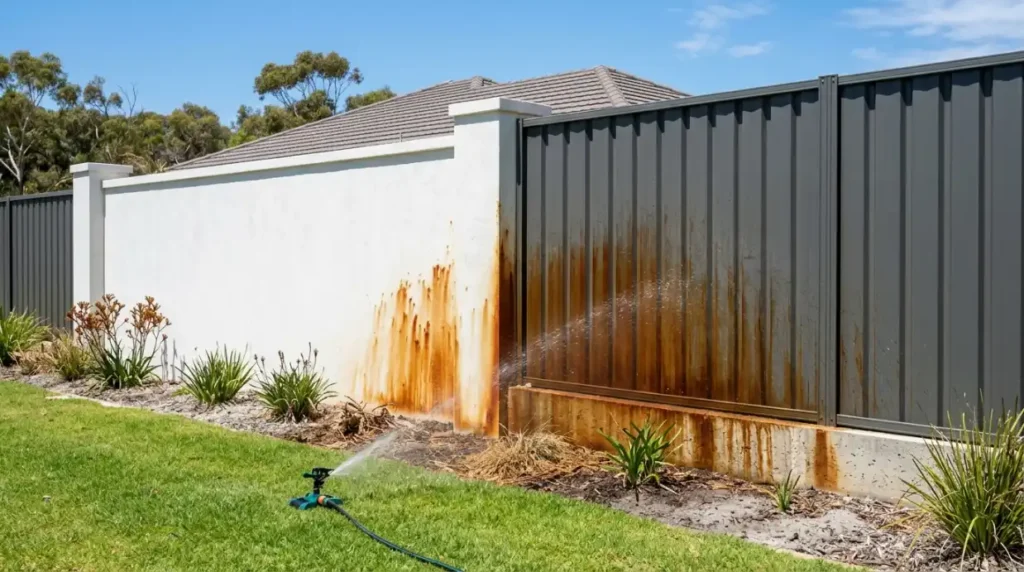
Quick answer: The short answer is yes, you can, but not just simply paint over bore water stains. Clean and rust, use a stain-blocking primer, and two coats of exterior-quality paint. Repair any sprinklers as well; otherwise, you will be getting stains again.
What causes bore water stains in Perth?
The Perth region has a large number of bores that produce shallow groundwater that contains dissolved iron. The water is clear as it emerges from the sprinkler. When it comes to rest on a surface and dries up, it becomes rusted, or in polite terms, oxidized.
In Perth, the situation is exacerbated. The stain is resistant to strong UV and summer heat, which bake the stain into the surface. With so many properties dependent on bores to maintain gardens, sandy soils and dry spells are a challenge.
The stains are at their worst when the same area is being hit day after day. Inspect boundaries, fence panels adjacent to reticulation, front render and paving.
The ability of different surfaces to absorb bore water stains.
Surface What happens What to know
Repainting is possible if the stain is in/under the paint film; call for painting with painted render or brick.
Acid or limestone (porous) will absorb into the surface. Do not use strong acids, as this will damage the surface.
Colorbond Stain applies over the coating. May clean up easily; wrong prep needs to be corrected before repainting.
Lacks properties; continues unaffected by soaks, and blends with weathering requirements; needs sanding and adding a stain blocker.
Concrete paving absorbs deeply. Cleaning is usually the answer, not paint.
Is it possible to address the water stains caused by bores by painting?
Yes, but not the first step; paint is the final step!
Regular exterior paint is meant to color and safeguard a surface. It does not stop iron staining from working. The little orange ghost often appears within weeks when you cover it up with paint, regardless of the color. I have seen it show up in the first sprinkler cycle in some instances.
First is a series: remove, seal, repaint. Move one step, and you will have to repeat the same task again.
When it comes to removing bore water stains before painting, all it can take is a bit of elbow grease.
Removing stains comes before painting is done. In the simplest terms, here’s what we do:
- Identify the stain. Orange-brown means iron. The white, crusty buildup is typically caused by salts and requires other types of fixes.
- Wash the surface. Apply low pressure and gently use detergent. Be careful not to damage the render by using a blaster, which can cause damage.
- Apply a rust stain remover. Often used products contain oxalic acid. Test a small concealed patch initially.
- Rinse to remove all dirt and dry thoroughly. Flooding with water damages the paintwork.
- Repeat if needed. Occasionally, a repeat of a softer impact stain comes with greater results than a chemical.
What not to use
- Chlorine bleach. It does not pick up iron and could actually make the stain more visible.
- S. on limestone, concrete or some bricks. They are able to “etch” the surface and can make permanent marks.
- Colourbond wire brushing. They remove the protective finish.
A bespoke approach is needed to remove the water stains and may not need the process of painting the entire surface.
Why a stain-blocking primer will matter: explain the importance of a stain-blocking primer.
Small amounts of iron are still present in the surface after cleaning. They won’t bleed into the fresh paint because of a stain-blocking primer.
There are oil-based and water-based stain blockers; the appropriate type to use is determined by the surface. This manufacturer data can be found on the data sheet of the product and substrate, and should be checked at all times.
For best results:
- Prime the whole surface or prime primarily if there are affected areas.
- Applications should be performed after the primer has completely cured.
- Then apply two coats of good quality exterior, 100% acrylic paint.
The most frequent cause for walls to stain after being repainted is failing to prime the surface properly before painting.
Fence painting Perth: But what is the difference?
Fences perform much differently from walls, and, in fact, the substance of the fence is significant.
Colorbond fences are now fenced without the necessity of painting. Borel stains can be removed by a proper clean. If you really want to change the color, the surface must be appropriately prepped and primed first; otherwise the paint will peel off. Review manufacturer’s warranty requirements prior to painting.
Timber fences absorb the stain and must be sanded, cleaned, stained with a stain blocker, and then painted/stained in accordance with Perth’s UV.
Limestone walls and fences: A lot of limestone walls and fences are found around Perth and are extremely porous. Here, cleaning should be carried out with care (as stated above).
When obtaining price quotes for fence painting in Perth, inquire about the preparation that is covered. Selling Egypt Stains does not always include stain treatment; it is often not part of the cheap quote.
If you are having trouble with stains, then you need to fix the source, or they will return.
If the sprinklers continue to water the same spot, you can do everything correctly, and the spots will continue to reappear. Some small things can be done:
- Rotate sprinkler heads and angles to ensure that there is no spray hitting walls, fences, and windows.
- Fit or remove overhanging heads.
- If the staining is bad, consult a bore or water treatment expert who may install an iron filter.
- Rinse off fresh stains promptly. These are far simpler to lift up compared to rusty stains, baked-in ones, and so on.
How not to do it…
- Skipping the stain removal process and just painting over it.
- Applying bleach or strong acids to the wrong surface.
- Not applying stain-blocking primer to save money.
- Repainting without making repairs to sprinklers
- Applying paint to wet surfaces.
- Prep is not for a dark-colored, stain-prone wall, nor are dark fence colors; They both run hot in a Perth summer.
What does it cost?
The prices are very diverse, so these estimates should be considered as a guide, and a written quote obtained:
- Cost of sheeting over small stained areas: typically hundreds of dollars.
- The price of fence painting is generally determined by the number of meters or panels of fence being touched and surface area; the color used, and the type of condition being dealt with.
- The factors that come into play when exterior wall surfaces are stained and repainted are surface area, access, and paint system.
The larger variable is, of course, prep. A job that requires stain treatment and priming is more expensive than simply painting the house, but it will last longer.
When it’s time to hire a professional
There are stains out there that are weekend chores. Others require an expert on their side. If a painter is advised:
- Stains are found on multiple walls or large areas of walls.
- The paint has come off, is bubbling and/or flaking, or is chalking.
- You have limestone, render, or old brickwork on the walls.
- You’re a landlord/property manager preparing for a tenant transition.
- The paint has not held up well, and other subduing paintings have already failed.
At the time of the assessment of a job, we review the type of surface, moisture, previous coatings, and the origin of the moisture. That would let us know if it’s a job to Clean and Seal, or if it’s a complete paint job.
Frequently Asked Questions
Can you paint over bore water stains?
Yes, but not directly. Bore water stains bleed through standard paint. Clean the surface, treat the rust, apply a stain-blocking primer, then paint with two coats of exterior acrylic. Without primer, the orange stain often reappears within weeks, even under quality paint.
How do you remove bore water stains from walls?
Wash the wall gently, then apply a rust stain remover suited to the surface, often one containing oxalic acid. Test a small hidden area first, rinse well, and let it dry. Avoid bleach and strong acids on limestone or concrete, as they can cause permanent damage.
Will bore water stains come back after painting?
They can, if the sprinklers still spray the same surface. Proper prep and a stain-blocking primer reduce the risk, but the best fix is redirecting the sprinklers. Without that, even a good paint job will eventually show orange staining again.
Can you paint a Colorbond fence with bore water stains?
Usually the stains clean off without repainting. If you do want to repaint, the surface must be cleaned, prepped, and primed with a product made for Colorbond. Poor prep leads to peeling. Check the manufacturer’s warranty conditions before you start.
How much does it cost to fix bore water stains in Perth?
It depends on the surface, area, and prep needed. Small cleaning jobs often cost a few hundred dollars, while full fence or wall repainting costs more. The most reliable way to know is a written, itemized quote after an on-site inspection.
Dealing with bore water stains on your walls or fences in Perth? Request a free, no-obligation quote from City Painters WA, and we’ll tell you honestly whether it needs a clean, a seal, or a full repaint.


