You have something dated: a kitchen where you’ve seen three decades of sunsets and a bathroom with bathroom tiles that no one purposefully picked the color. It will cost a lot to rip everything out and will be dirty. So, can you paint over wallpaper, tiles, and laminate?
Often, yes. Suppose the prep is right, however. Usually, bubbles and curling around the edges of the wallpaper are visible within a few weeks of the person painting over it, rather than sealing the area first and then painting over the wallpaper. Tiles and laminate are traps in their own right.
Seeking to find a friendlier, a more hostile, and what a person will be looking for before they reach out for a roller. So what characteristics one can find in a Perth home, what one cannot, and certainly what a pro will be seeing prior to accepting a roller.
Quick answer
Wallpaper can be removed from walls if it is smooth, tightly attached, and doesn’t have too much moisture. Any wall in the bathroom can be adorned with tiles to suit the requirements of designing suitable paintings by employing the correct primer and the corresponding tile paint. Laminate and light scuff and bonding primer are good choices to use to paint laminate cabinets. Prep is not to be skipped, or the paint will peel, chip, or lift.
Is It Legal To Paint Over Wallpaper?
Yes, under certain circumstances. The wallpaper needs to be good quality, as the paint will only be secure as long as the wallpaper is secure.
When it works
It makes sense for the paint to be applied over wallpaper when:
- No lifting edges or bubbles in the paper; it bonds tightly.
- The surface is slightly roughened or lightly decorated. The surface is somewhat patterned or embellished.
- No damp patches or mould are seen.
- It’s not a foil or highly embossed paper; it’s a vinyl paper or regular paper;
- It is important to distinguish when to strip it and when not.
When to strip it instead
Remove wallpaper if there are seams that curl up, walls that are textured, or if there is moisture behind the wallpaper. Older homes in Perth may have damp around bathrooms, laundries, and external walls that may be concealed by the paint and which will cause damage.
Water-based paint will also reactivate old wallpaper glue. That is how bubbles are formed.
How a Professional does it
Normally, when we have wallpaper in good condition, when we paint, we do this:
- Go over all seams and edges, and glue in place any loose parts.
- Wipe the surface to eliminate dust, grease, and nicotine.
- Close any openings and smooth any joints.
- Prime with special or oil-based wallpaper primer. This prevents stains from permeating and repels the paint from the glue.
- Paint twice with a good interior paint.
Although well prepared, seams can still “ghost” through with strong afternoon light. You should be aware of this before you get into a commitment.
Are you wondering whether or not you can paint bathroom tiles?
Although it’s possible to paint bathroom tiles, it’s another job than painting a wall! Ordinary paint and glued tiles will not adhere to the tiling.
Requires a good clean to remove “soap” scum, a degreaser, and a light abrasion, followed by a tile-specific primer. Next, an epoxy or factory-produced tile paint.
Painted tiles can be used on feature walls, surrounds of splashbacks and basins. Never place a shower floor or a watered-down area. Many other finishes are equally hard as wall paint but will not have the original glaze; therefore, some touch-ups will have to be done over the years.
There is another set of catches: grout lines. The first place to chip is along them, so a good painter either seals the grout or allows the paint to fully encase the grout.
How to Paint Kitchen Cabinets and Laminate?
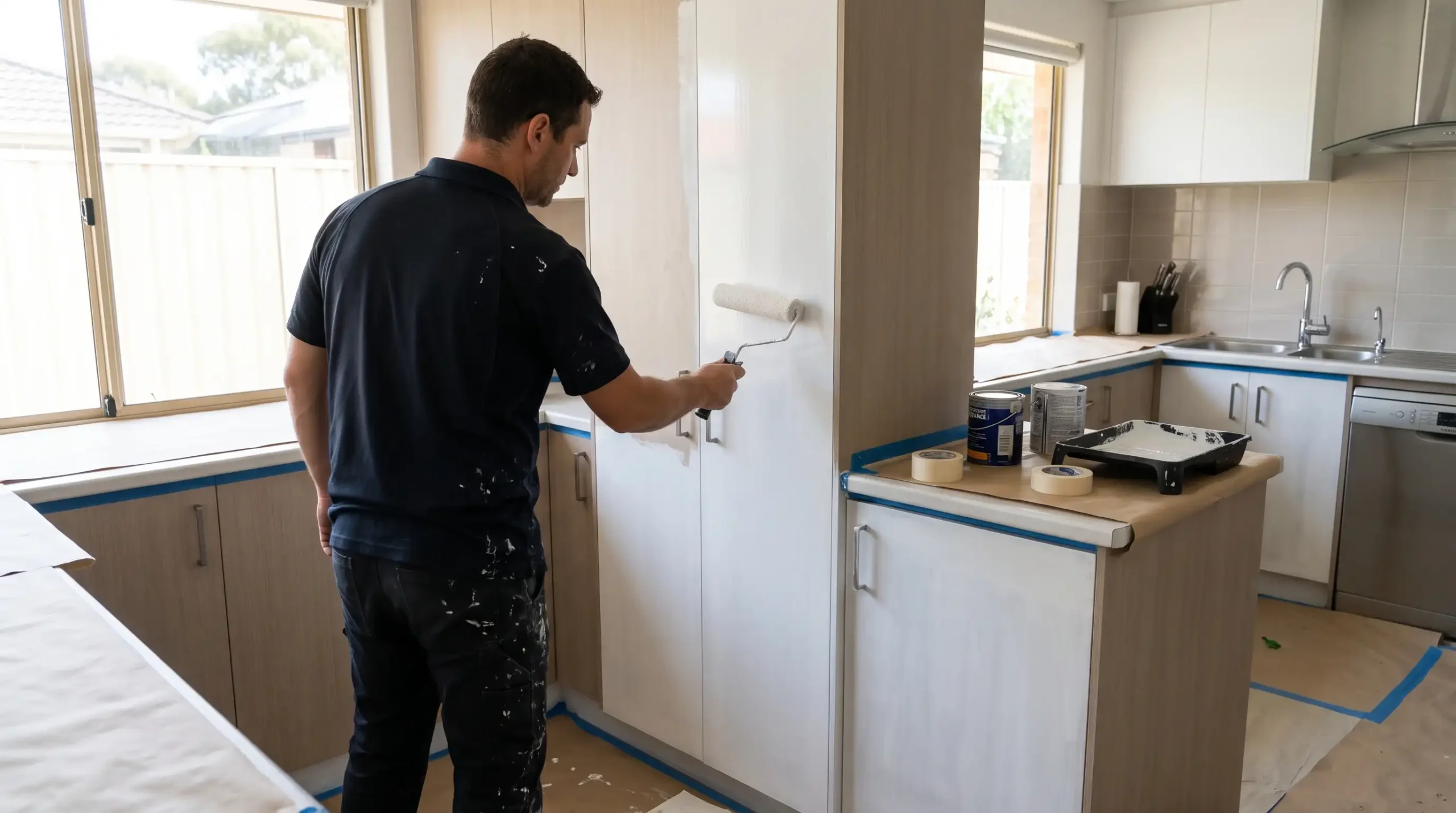
Upgrading your home kitchen cabinets is one of the most cost-effective kitchen renovations. The doors are solid, and the laminate is in decent condition; you can paint over laminate and achieve the look of a new kitchen.
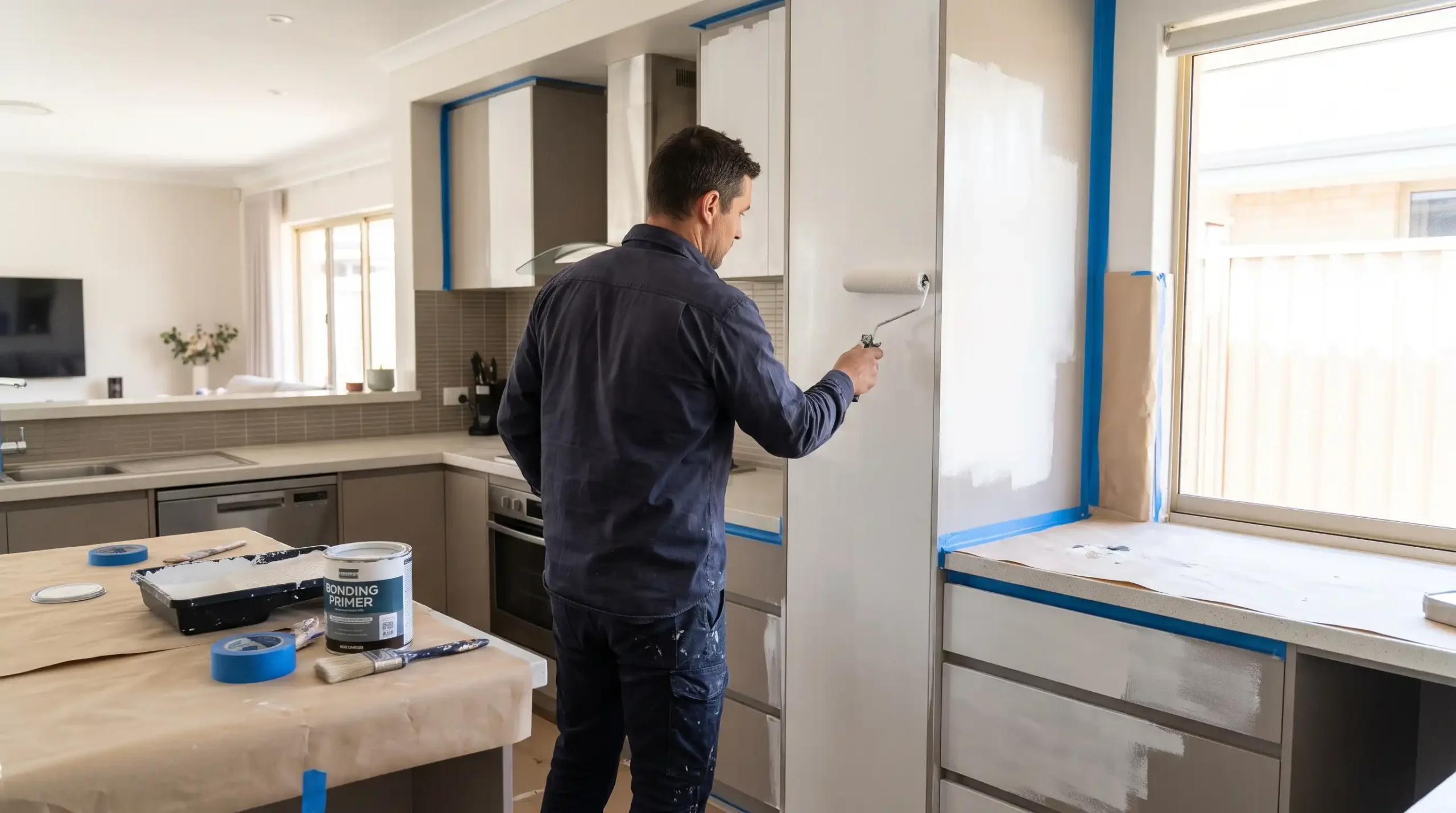
Now, the problem is laminate, which is smooth and not porous. Paint floats on the top of the surface unless you use wood-fur-strip preparations.
What preparatory activity means asynchronously
- Degrease thoroughly. You can’t see cooking oil in kitchen cabinets.
- Lightly scuff-sand the surface.
- Use a bonding primer for glossy surfaces if required.
- Use a tough cabinet enameled paint, not straight wall paint.
- Allow each coat to dry thoroughly before reinstalling doors back into place.
What to check first
Pay attention to the outlines. Repair or replace any laminate that is peeling, swollen due to water damage, or has chipped around corners before painting them. What can’t be mended with paint can’t be mended.
Look at the items around the cooktop and dishwasher. The first tests of a paint finish are heat and steam.
Which Surfaces Can Be Painted? A Quick Comparison
| Surface | Can it be painted? | Key prep | Main risk |
|---|---|---|---|
| Wallpaper | Yes, if smooth and well bonded | Fix seams, clean and oil-bond or seal with wallpaper primer | Bubbling seams showing |
| Bathroom wall tiles | Yes, with tile paint | Degrease, abrade, and apply tile primer and epoxy paint | Chips at grouting; erodes in wet areas |
| Laminate cabinets | No, if damaged, but can be repaired by enameling with bonding primer if chipped and protruding sections can be degreased and chipped portion repaired with cabinet enamel | Degrease, bonding primer, cabinet enamel | Chipping |
| Concrete-floored showers | Not recommended | Replace or re-tile instead | Constant water, peeling |
Perth Conditions: What do they mean to Painted Surfaces?
More than people realize, Perth’s climate is significant. Cabinets may give up the shape and form of their surface due to the intense heat of summer; wallpaper seams can become dry and flake in houses with west-facing walls and no ventilation.
Salt is another issue on coastal homes located from Cottesloe to Mandurah, as it forms a coating on surfaces. Prior to application of any primer, it must be washed off.
WA homes built in the 80s and 90s are often provided with wallpaper borders, laminate kitchens and dated tiles. They can be good candidates for cosmetic work if the surface underneath is in good condition.
The basket is made up of common mistakes to steer clear of.
- Skipping primer. It is the most common cause of paint failing to adhere to laminate, tiles, and wallpaper.
- Using wall paint on cabinets. Scratches and marks easily.
- Applying paint to wet or mildew-ridden areas. The blistering paint will cause the problem to reappear.
- Allowing the curing time to be too short. Until cabinet paint is hard, it will feel dry.
- Ignoring loose seams. Each edge that is lifted will form a bubble when painted.
- Selecting gloss level after just studying the appearance. The higher the sheen, the more flaws are evident in the wallpaper and old laminate.
If anyone gives you a quote for painting over wallpaper or tiles and doesn’t say primer, you have a red flag.
There were cost and time considerations. Cost and time factors were important.
The prices range greatly depending on the quality of the surface and also the size of the work to be done. In general:
- Over-painting wallpaper: These are usually less expensive than stripping and repainting the wall, as it can be quite time-consuming to remove wallpaper and repair walls.
- Bathroom tile painting: usually a few hundred to a couple of thousand dollars, depending primarily upon locality.
- Cabinet painting services: anywhere from a few thousand dollars for an average kitchen to a bit more if you’re painting full doors or if you go for a bigger kitchen.
Usually, cabinets take a few days to make since they have drying/curing between coats. It’s sometimes faster and more cost-effective to do a wallpaper or tile job, but it depends on the extent of the work that needs to be performed first.
The only way to be able to quote accurately is by conducting a site inspection. This is typically more economical than doing it right the first time, then having to do it again a year later.
Frequently Asked Questions
Can you paint over wallpaper without removing it?
Yes, if the wallpaper is firmly stuck, smooth, and in good condition. Seal it with an oil-based or specialty wallpaper primer, then apply two coats of quality paint. Peeling edges, heavy texture, or damp patches mean it’s better to strip it first.
Can you paint over laminate cabinets?
Yes. Clean off grease, scuff sand lightly, apply a bonding primer, then use a durable cabinet enamel. Skipping the bonding primer is the main reason paint chips off smooth laminate. Allow proper curing time before heavy use.
Can you paint bathroom tiles?
Yes, on walls, using tile primer and epoxy or tile paint after a thorough clean and degrease. Avoid shower floors and areas under constant water. Painted tiles are less durable than the original glaze, so expect more care and occasional touch-ups.
Do you need to sand laminate before painting?
A light scuff sand helps paint grip, but it’s not enough on its own. Pair it with thorough degreasing and a bonding primer made for glossy surfaces. Some primers need less sanding, so always follow the product’s data sheet.
Is it better to remove wallpaper before painting?
Removing is usually better for peeling, textured, or damp-affected wallpaper, because it gives a smoother, longer-lasting finish. Painting over good, tightly bonded wallpaper can save time and cost, but seams may show in strong light.
So, Should You Paint Over Wallpaper, Tiles or Laminate?
If you’re unsure whether to paint over wallpaper, tiles or your kitchen laminate, City Painters WA is happy to take a look. Request a free quote and get honest advice on what’s worth painting and what’s better replaced, across Perth, with no pressure.